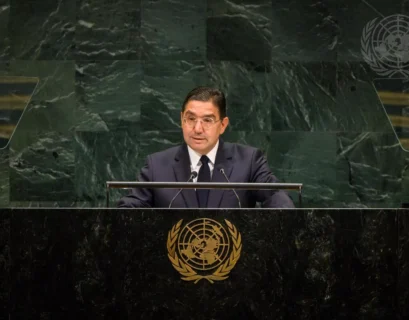


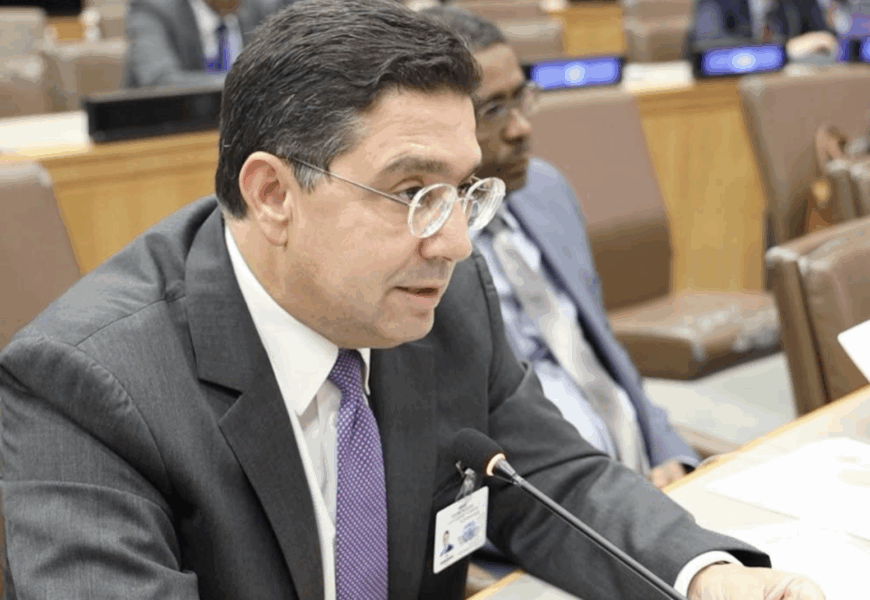
Morocco’s Minister of Foreign Affairs, African Cooperation and Moroccan Expatriates, Nasser Bourita, said on Thursday during a United Nations Security Council meeting held under the Arria formula that Morocco views the management of straits as a responsibility rather than a form of ownership, calling for an initiative to develop a code of conduct for countries bordering these maritime passages.
Speaking at the meeting, organized by Bahrain under the theme “Safe Seas, Shared Security: Protecting Freedom of Navigation in an Evolving Security Environment,” Bourita stressed that Morocco is not merely a coastal state, but also a country that assumes direct responsibility for the management and security of the Strait of Gibraltar, one of the world’s most important maritime routes.
In this context, Bourita noted that nearly 100,000 vessels pass through the strait every year, equivalent to around 300 ships per day, or one vessel every five minutes.
Navigation through the Strait of Gibraltar is five times greater than through the Suez Canal, eleven times higher than through the Panama Canal, and nearly three times more intense than through the Strait of Hormuz, he pointed out.
The minister stressed that Morocco does not view its geographical position as a privilege or as a tool for pressure or blackmail, but rather as an international responsibility and a lever in support of international cooperation, stability and development.
Against this backdrop, Bourita told participants at the meeting that Morocco is calling for reflection on the development of an international code of conduct in support of freedom of navigation, based on the principle that international maritime routes should remain open, safe and predictable spaces.
To this end, the minister proposed that Morocco, in coordination with the Kingdom of Bahrain, host an international forum aimed at strengthening adherence to the rules of international law, promoting the exchange of best practices, and ending the polarization between those who claim ownership of these strategic passages and those who seek to exploit them for blackmail.
Bourita also said that seas and oceans constitute essential global infrastructure which, despite its vital importance, remains fragile, making it a vulnerable target for covetous interests and malicious designs.