

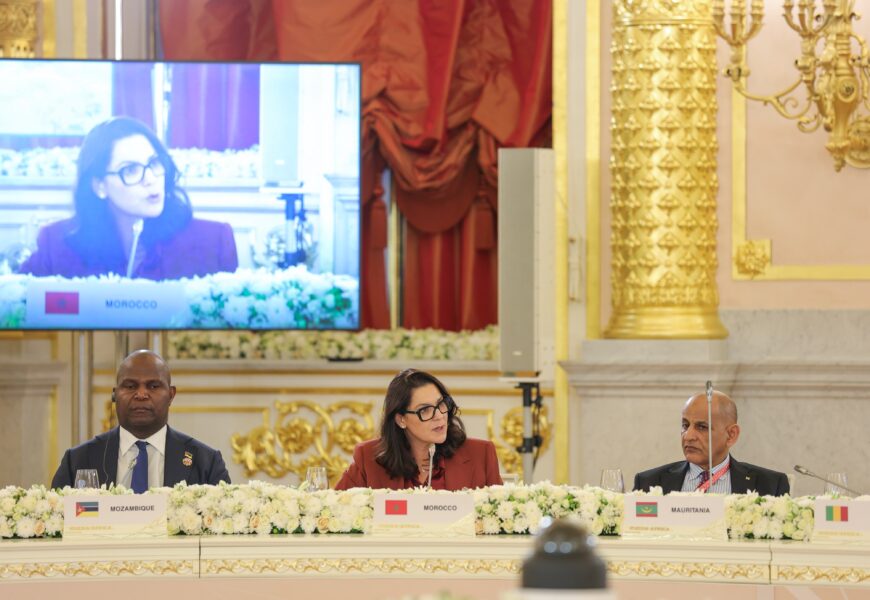
Representing His Majesty King Mohammed VI at the Third Russia-Africa Summit, Head of Government Fatima Ezzahra El Mansouri stated in Moscow that the Sovereign has always made Africa a high priority of the Kingdom of Morocco’s foreign policy.
This Royal conviction, Fatima Ezzahra El Mansouri explained in her address to the Third Russia-Africa Summit, is reflected in far-reaching, transformative initiatives of unprecedented scale, namely the Atlantic African States Initiative, the Royal Initiative to Facilitate Access to the Atlantic Ocean for Sahel Countries, which seeks to end the region’s isolation through modern infrastructure, and the Nigeria-Morocco African Atlantic Gas Pipeline, which anchors integration, shared development, and stability throughout West Africa, El Mansouri emphasized during the Summit’s plenary session.
In this regard, she added that His Majesty King Mohammed VI remains convinced that Africa needs all its international partners, noting that every model of cooperation brings added value, provided it forms part of a broader framework of complementarity, is based on mutual respect between African countries and their partners, and aims to foster active cooperation and concrete action.
The Head of Government stated that “the Russia-Africa Partnership is reaching a turning point: the transition from planning to action, enabling our platform to realize its full potential,” noting that the action plans adopted in Sochi and St. Petersburg had laid important foundations.
“Today, these plans must also be adapted to the African continent’s priorities: food security, energy security, industrialization, and technology transfer,” she said, stressing that the Russia-Africa Partnership would benefit from focusing its efforts on these areas in the years ahead.
El Mansouri further noted that Morocco, in keeping with His Majesty the King’s Vision, remains committed to this partnership and, through the Summit, reiterates its willingness to help launch concrete and innovative avenues of cooperation. She added that the Kingdom “stands ready to support this initiative by drawing on the full strength of its experience, within the framework of the shared values that govern our relations.”
“Is there still a need to emphasize that it is not only Africa that needs the rest of the world, but that the rest of the world also increasingly needs Africa?” she said, adding that the African continent draws its strength from its natural resources, human capital, geographical position, and historical, cultural, and political wealth, all of which give it an increasingly important role.
Seven years after Sochi and three years after St. Petersburg, this Summit marks a milestone for the Russia-Africa Partnership, which has already recorded significant achievements, including institutionalizing meetings, strengthening political dialogue, adopting action plans, launching cooperation initiatives in food security, energy, infrastructure, healthcare, education, training, and technology transfer, and enabling trade between Russia and the African continent to exceed $27.7 billion in 2025, El Mansouri recalled.
“This Third Summit is not merely an opportunity to celebrate a commendable record of achievements, but above all an occasion to identify the next steps,” El Mansouri emphasized, noting that it is important to recognize that as the Partnership’s institutional framework grows stronger, the expectations of African nations are also increasing, particularly regarding food security, energy, development, and economic sovereignty.
Turning to relations between Morocco and Russia, the Head of Government highlighted that ties between the two countries are rooted in centuries of friendship and have been considerably strengthened since the establishment of the Strategic Partnership in 2002, followed by the Deepened Strategic Partnership during the Royal Visit to Moscow in 2016.
She noted that the Kingdom now ranks among Russia’s top three economic partners in Africa, recalling that bilateral trade reached $630 million in 2025, while Moroccan exports increased by 18%. In addition, more than 7,000 Moroccan students pursued their studies in Russia during the 2024–2025 academic year.
“Despite a complex geopolitical environment, we can take satisfaction in the fact that our exchanges have remained at appreciable levels,” she said.
El Mansouri also pointed out that further areas of cooperation, particularly in energy, science, and technology, deserve greater exploration.
She explained that this shared determination to deepen “our political dialogue and explore new horizons for cooperation was demonstrated by the recent establishment of a Working Committee between our two Ministries of Foreign Affairs, which held its first meeting in September 2026.”