“Morocco is a model of African development. We have much to learn from the vision of His Majesty King Mohammed VI.”
— Paul Kagame, President of Rwanda
This phrase, spoken with sobriety by one of the most respected heads of state on the continent, conveys much more than a simple tribute. It reflects the evidence of an exceptional reign, whose scope transcends the Kingdom’s borders. For King Mohammed VI has not merely modernized Morocco. He has built an unprecedented political and diplomatic architecture that today serves as a reference.
From the moment of his accession, the Sovereign made a choice: that of quiet reform, of lasting transformation, without ever giving in to haste or the temptation of spectacle. The reform of the Moudawana, the gradual expansion of social protection, the rise of the national economy… All this bears the mark of a head of state who thinks deeply and acts for the long term. In twenty-six years, Morocco has tripled its gross domestic product, established itself as a continental industrial hub, and above all, placed the citizen at the center of the national project.
Yet it is in the realm of diplomacy that the royal vision perhaps reveals its greatest uniqueness. A diplomacy founded on principles—sovereignty, respect for international law, solidarity with peoples—but never frozen. A diplomacy of non-alignment, refusing ideological automatisms, privileging alliances of both heart and reason. Morocco is neither a follower nor a giver of lessons. It engages, it connects, it proposes. And above all, it matters.
Through the royal voice, our country has become a respected interlocutor on the world’s major issues: peace, security, climate, and shared development.
His Majesty’s African policy is a masterful illustration of this. As early as 2008, in Abidjan, the King laid out a vision of a continent freed from external dictates, betting on intra-African cooperation, on sustainable “win-win” partnerships, on shared sovereignty. A discourse once isolated, it has now become a model. Morocco has built an exemplary African presence: economic partnerships, infrastructure projects, humanitarian support, knowledge transfers… A lived diplomacy, far from slogans.
But because he looks far ahead, the Sovereign also places the Kingdom within future dynamics. The Atlantic project is not merely a vision: it is a rare, deep strategic projection, where Africa seizes its geography to create its own centrality. Morocco does not simply observe the horizon: it builds it. The port of Dakhla is its cornerstone. But the royal ambition goes beyond infrastructure. It seeks to allow all countries, including those deprived of a coastline, to access the great global economic flows. It is a vision of active solidarity, rooted in common interests and oriented toward future generations.
This greatness of vision is accompanied by the simplicity of gesture. King Mohammed VI has forged with his people a bond of rare depth. A closeness without artifice. A relationship built on listening, respect, and mutual loyalty. In times of trial, the people find their Sovereign. In times of hope, they advance at his side. This bond is the invisible heart of Moroccan stability. It cannot be decreed. It must be earned. And it is passed on.
That transmission, precisely, is at the foundation of the Moroccan Monarchy. A living institution, rooted in history, yet resolutely contemporary. Within its traditions, one expression often refers to the Crown Prince: “Smiyet Sidi.” It conveys the idea of active filiation, of ongoing education, of continuity in the service of the Nation. It is not only an inheritance of blood. It is an inheritance of duty. The duty to unite, to guide, to carry high the hopes of a people.
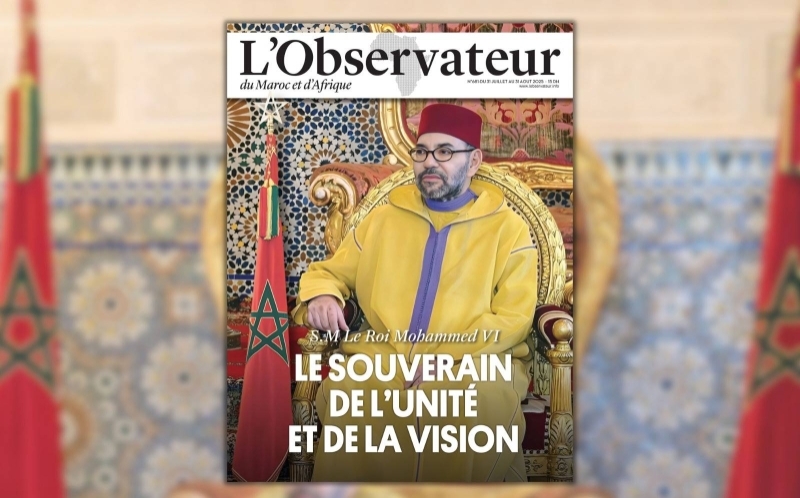
Mohammed VI is a Sovereign of unity. He has managed to federate without ever uniformizing. He has built a national consensus around shared values: dignity, work, justice, openness. He is also a Sovereign of vision. A vision that is concrete, patient, constructive. A vision that commits the Kingdom, but inspires far beyond its borders.
This is not mere celebratory rhetoric. It is a profound truth. And it is our future.