

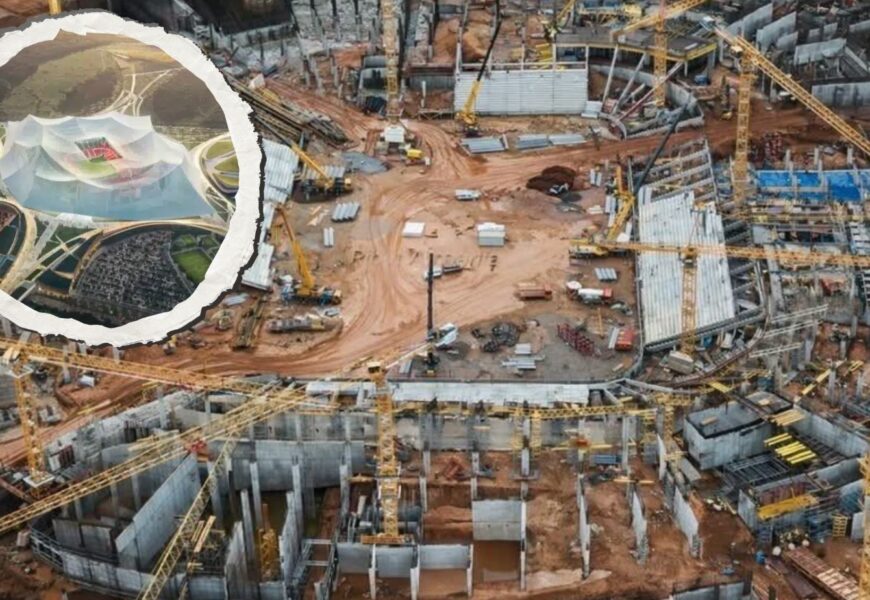
With its future 115,000-seat Grand Stade Hassan II and preparations progressing at a rapid pace across the six Moroccan host cities, the Kingdom is determined to make its case in the race to host the 2030 World Cup final. FIFA’s next inspection visit, scheduled to begin on November 28, will provide an opportunity to demonstrate the strength of Morocco’s bid in the face of political grandstanding by certain Spanish voices, whose tactics are clearly offside.
The contest to host the 2030 World Cup final will be decided on the field, far removed from attempts at political manipulation and the futile, sterile rhetoric of certain Spanish officials, some driven by electoral calculations and others by nostalgia for a bygone era of grandeur.
In the race to stage the most prestigious match in world football, Morocco holds a powerful advantage. The future Grand Stade Hassan II in Benslimane will offer a capacity of 115,000 spectators. With its exceptional size, state-of-the-art facilities and supporting infrastructure, it is set to become the world’s largest football stadium by seating capacity. This represents a major advantage over Madrid’s Santiago Bernabéu, which seats fewer than 90,000 spectators, and Barcelona’s Camp Nou, whose capacity is expected to reach 104,600 following renovation. Both Spanish stadiums are also contenders to host the final.
Yet the strength of Morocco’s bid extends well beyond the impressive scale of this future stadium. Its architecture, cutting-edge facilities, hospitality infrastructure and planned transport connections are all compelling arguments that are certain to attract FIFA’s attention.
Far more than a sporting venue, the Benslimane project, where construction work on a monumental scale is advancing at a sustained pace, embodies a much broader ambition. It aims to offer players, spectators and millions of television viewers an experience worthy of the global spectacle that a World Cup final represents.
Starting November 28, a new FIFA inspection visit to Morocco is expected to provide a concrete assessment of the scale and progress of preparations. The mission will cover the six cities designated to host matches during the 2030 World Cup, namely Rabat, Casablanca, Tangier, Marrakech, Agadir and Fez. This will mark an important step in the evaluation of infrastructure and the allocation of the tournament’s various matches.
According to available information on the progress of preparations, ongoing projects have reached a particularly satisfactory stage of completion. Several are even ahead of their original schedules. This momentum reflects the commitment of the various stakeholders and the effectiveness of their coordination in meeting FIFA’s requirements and established deadlines.
Beyond the stadiums, an entire network of infrastructure and services is undergoing accelerated transformation. Urban mobility, rail networks, airport capacity, hotel accommodation and urban development are benefiting from investments designed to ensure optimal conditions for national teams, supporters and visitors. Far from serving only the requirements of the 2030 World Cup, these projects form part of the Kingdom’s long-term modernization and development strategy.
The benefits of the 2030 World Cup will also extend far beyond the six host cities. Several other Moroccan cities and regions will be directly involved in the tournament, particularly by accommodating the participating national teams’ base camps. This will provide an opportunity to spread the economic, tourism and infrastructure benefits of the competition across a broader part of the country.
This nationwide momentum will constitute another major asset during the upcoming inspection. According to the information provided, FIFA representatives had already expressed particularly positive assessments following their initial evaluation mission to the six Moroccan host cities.
Another major strength lies in the mobilization of the Moroccan people and their collective embrace of this historic event. In accordance with the enlightened Vision of HM King Mohammed VI, preparations have brought together all relevant stakeholders. Public authorities, local governments, infrastructure agencies and national operators are joining forces to ensure the tournament’s success. The National Airports Office (ONDA) and the National Railways Office (ONCF), in particular, play a decisive role in improving the Kingdom’s connectivity and expanding its transport capacity.
In the race to host the final, Morocco intends to counter rhetoric with achievements and political grandstanding with tangible results. Although FIFA has yet to decide between the competing bids, the Kingdom can point to concrete strengths and a clearly defined ambition.
Against certain Spanish claims, accompanied by a misplaced rhetoric of superiority that runs counter to the spirit of partnership and mutual respect underpinning this joint World Cup, the future Grand Stade Hassan II and the momentum of Morocco’s preparations could weigh heavily in the balance.
Ultimately, the decision on who will host the 2030 World Cup final must rest on the quality of infrastructure, hosting capacity, organizational excellence and the credibility of commitments. Not on rhetoric, and certainly not on prejudice.
As Fouzi Lekjaâ, President of the Royal Moroccan Football Federation, has repeatedly emphasized, the outcome must be decided on the pitch, and on the pitch alone.