

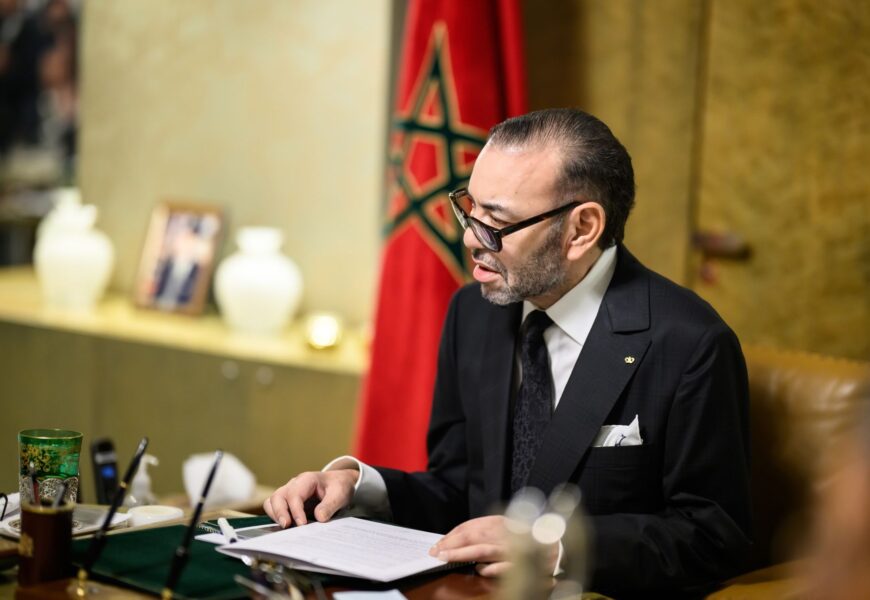
Royal diplomacy has established a new strategic reality. It now falls to our Algerian neighbors to recognize its implications and choose between the dead ends of the past and the possibilities of the future.
Recent diplomatic developments concerning the Moroccan Sahara have brought several fundamental realities into sharp focus. They concern Morocco’s standing in the international order, the significance of the King’s strategic vision, and the choices now confronting our Algerian neighbors.
These realities demand a clear-eyed assessment, for they bear directly on the security, prosperity, and future of two nations.
The first concerns the place of the Moroccan monarchy in the international strategic order.
In a world increasingly defined by uncertainty and great-power rivalry, stability, institutional continuity, and the credibility of national commitments have become major geopolitical assets.
Under the leadership of His Majesty King Mohammed VI, Morocco has made these qualities the foundations of a respected and effective diplomacy.
In Washington, the Kingdom is regarded as a strategic partner of the first order. In Paris, London, Berlin, Beijing, and Moscow, despite sometimes divergent interests and diplomatic positions, Morocco remains a valued interlocutor whose stability and capacity for dialogue carry considerable weight.
This standing reflects a vision that extends beyond immediate national interests.
At the crossroads of Europe and Africa, the Atlantic and the Mediterranean, Morocco is steadily transforming its geography into a source of economic, logistical, and energy-related strength.
The Moroccan monarchy has grasped a fundamental transformation of the contemporary world: a nation’s power is no longer measured solely by its military capabilities, but also by its ability to connect economies, secure trade, and contribute to international stability.
The second reality concerns the foresight of royal diplomacy on the Sahara.
For decades, Morocco has maintained a consistent position while demonstrating a remarkable ability to anticipate and adapt to shifting geopolitical circumstances.
This strategy, grounded in patience, realism, and coherence, has yielded significant results.
United Nations Security Council Resolution 2797 marked a decisive turning point by establishing Morocco’s autonomy plan as the basis for negotiations and recognizing that genuine autonomy could represent one of the most feasible paths toward a lasting settlement.
This is a major diplomatic achievement. Yet the true significance of Morocco’s initiative extends far beyond diplomacy itself.
The Moroccan proposal was never intended to exclude the Sahrawi population. Its purpose is to offer them a future.
Autonomy must enable Sahrawis to participate meaningfully in governing their own affairs, guarantee their political representation, and create the conditions for shared prosperity.
It must open new horizons for younger generations, reunite families, and transform the region into a place of development and opportunity.
It is in this human dimension that the strength of the King’s vision also resides.
The third reality concerns Algeria directly.
Morocco does not seek confrontation with its neighbor. This choice stems neither from weakness nor from fear.
The Kingdom possesses professional armed forces, modernized defense capabilities, and an unwavering determination to safeguard its sovereignty.
But true strength also lies in understanding that a war between Morocco and Algeria would be a tragedy from which neither country could emerge as a genuine victor.
Such a conflict would claim lives, jeopardize decades of development, and create new security vulnerabilities.
The hand repeatedly extended to Algeria by His Majesty King Mohammed VI reflects this profound sense of responsibility. It embodies a fundamental conviction: two nations can defend their interests without condemning their peoples to permanent confrontation.
Nothing obliges Algeria’s leaders to allow a dispute inherited from the past to define their nation’s future.
Today, they have an opportunity to reassess their policies in light of a changing world and the long-term interests of their own country.
Morocco, for its part, will continue on its chosen path.
With serenity, determination, and confidence in the strength of its institutions.
The Moroccan monarchy has demonstrated its ability to pursue a long-term vision of statecraft, anticipate international transformations, and reconcile the steadfast defense of its fundamental interests with an enduring commitment to openness.
Perhaps this is the fullest expression of the King’s strategic vision.
Morocco does not need confrontation to assert its power.
Its strength gives it the confidence to choose peace without ever compromising its convictions.