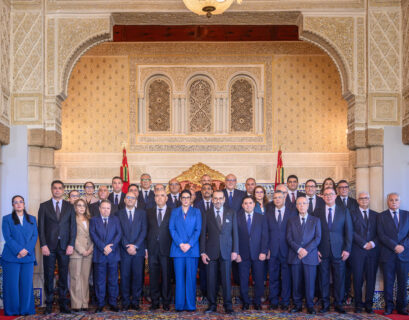


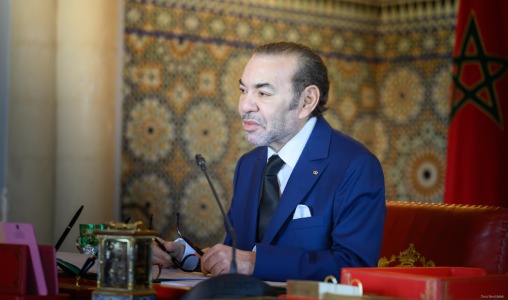
His Majesty King Mohammed VI chaired, on Thursday at the Royal Palace in Rabat, a Council of Ministers, according to a statement from the Royal Cabinet. Here is the translation:
“His Majesty King Mohammed VI, may God assist Him, chaired, on Thursday, April 9, 2026, corresponding to 21 Shawwal 1447 AH, at the Royal Palace in Rabat, a Council of Ministers devoted to the approval of two draft organic laws, a draft decree relating to the military domain, as well as a set of international agreements and appointments to high-level positions.
At the beginning of the Council’s proceedings, His Majesty the King, may God preserve Him, questioned the Minister of Agriculture, Maritime Fisheries, Rural Development and Water and Forests on the progress of the current agricultural season.
The Minister stated that this season has been marked by very significant rainfall, which contributed to reviving various agricultural activities, thus heralding promising prospects for the agricultural harvest.
These precipitations affected all regions of the Kingdom, with an annual average reaching 520 millimeters, representing an increase of 54% compared to the annual average of the past thirty years. This had a positive impact on dam reserves, which now amount to 12.8 billion cubic meters, with a filling rate of 75%. These reserves will enable the country to meet irrigation water needs for spring and summer crops, as well as for the beginning of the next agricultural season.
Regarding fruit trees, Morocco recorded significant production of olives, citrus fruits, and dates, with a record production of 2 million tons of olives, an increase of 111% compared to the previous year, 1.9 million tons of citrus fruits, an increase of 25%, and 160,000 tons of dates, up by 55% compared to the last season.
In implementation of the High Royal Instructions concerning the reconstitution of the national livestock, the Minister stressed that these rains contributed to the abundance of pastures and the improvement of livestock conditions.
Subsequently, the Minister of the Interior presented to HM the King, may God glorify Him, a report on the main guidelines for the governance of the new generation of integrated territorial development programs, based on a new approach that sets program priorities according to needs expressed locally by citizens, in accordance with the enlightened guidelines of HM the King contained in numerous Royal Speeches.
The overall design of this major reform project reflects the High Royal Will to make the improvement of citizens’ living conditions and the preservation of their dignity the ultimate goal of all public policies, through strengthening territorial attractiveness, stimulating economic growth, and creating jobs.
The Minister indicated that the preparation of these programs was based on extensive consultation and listening processes across all prefectures and provinces of the Kingdom. Territorial diagnoses were established for each prefecture and province based on the analysis of various socio-economic indicators, and the identification of strengths and weaknesses in access to employment, education, healthcare, water, and territorial upgrading programs.
He emphasized that the initial estimates of the overall budget for the implementation of these programs amount to nearly 210 billion dirhams over a period of 8 years.
In line with the High Royal Guidelines aimed at adopting a renewed approach, a comprehensive plan has been established defining governance, implementation, and evaluation mechanisms for this new generation of programs, as well as related communication systems.
At the governance and steering level, an approach has been adopted that originates at the local level, responsible for design and monitoring, while the national level handles overall coordination and mobilization of the necessary funding.
Thus, at the local level, a committee will be created chaired by the governor of the prefecture or province and composed of elected officials and representatives of decentralized state services. Its mission will be to design programs, monitor project implementation, and consult with target populations to meet their needs, while ensuring the promotion of the regions’ potential.
The Wali of the region will chair a committee responsible for consolidating integrated territorial development programs for the prefectures and provinces of the region, while ensuring project harmonization.
At the national level, a national committee chaired by the Head of Government will be created. It will include relevant ministerial departments and will be responsible for validating programs, ensuring their integrated and participatory nature, and establishing monitoring and evaluation indicators to measure their impact.
Regarding implementation mechanisms, joint-stock companies will be created whose boards of directors will be chaired by regional council presidents. These companies will replace Regional Project Implementation Agencies, enabling a balance between governance and public oversight requirements, and management flexibility and performance efficiency inspired by the private sector.
In terms of control and accountability, the implementation of these programs will be subject to an annual audit conducted jointly by the General Inspectorate of Finance and the General Inspectorate of Territorial Administration to assess performance and ensure compliance with execution procedures.
To ensure broad communication around integrated territorial development programs, a dedicated digital platform will be created, allowing citizens and institutional stakeholders to access all information related to programming, project progress, and implementation, thereby ensuring maximum transparency and regular monitoring.
Subsequently, the Council of Ministers approved a draft organic law amending and supplementing the organic law relating to regions.
This project is in line with the enlightened Royal Vision aimed at establishing strong and productive advanced regionalization capable of addressing development challenges and reducing inequalities and spatial disparities.
It also aims to establish a legal and institutional framework ensuring optimal and efficient implementation of the new generation of integrated territorial development programs, based on three main axes: implementation mechanisms, regional competencies, and financial resources.
Regarding implementation mechanisms, regional project execution agencies will be transformed into joint-stock companies to reconcile governance and public oversight requirements with management flexibility and performance efficiency, thereby improving project quality and accelerating implementation.
Concerning competencies, this reform provides an opportunity to clarify and redistribute the region’s own and shared powers, focusing on its role as a key lever for economic development.
Regarding financial resources, the project aims to strengthen the financial capacities of regions by increasing the ceiling of State financial transfers to their budgets, enabling them to fully exercise their competencies, enhance financial autonomy, and ensure effective and regular contributions to financing and implementing integrated territorial development projects.
The Council of Ministers also adopted a draft organic law amending and supplementing the organic law relating to appointments to senior positions. This project aims to amend and supplement annexes 1 and 2 through:
- The addition of the “National Agency for Child Protection” to the list of strategic public institutions whose leaders are appointed following deliberation in the Council of Ministers.
- The renaming of the “Mohammadia Foundation for Social Works of Magistrates and Justice Officials” to “Mohammadia Foundation for Social Works of Justice Officials.”
- The addition of the position of “General Judicial Registrars” to the list of senior positions within public administrations subject to deliberation in the Government Council.
During this Council of Ministers, HM the King, Supreme Commander and Chief of General Staff of the Royal Armed Forces, approved a draft decree supplementing the decree relating to the status of military attachés, their assistants, and other military personnel assigned to their service.
This project, implemented in accordance with High Royal Instructions, aims to complete the list of military attaché positions abroad, as provided for in Article 1 of Decree 2.65.046 of 6 Moharram 1385 (corresponding to May 7, 1965), whose holders benefit from a monthly allowance for specific charges.
As part of strengthening the Kingdom’s contractual network, reflecting the forward-looking Royal foreign policy based on fruitful and responsible cooperation and consolidating Morocco’s position as an open country working to strengthen cooperation with its brothers and partners, the Council of Ministers adopted 15 international agreements (11 bilateral and four multilateral).
The bilateral agreements concern air transport, judicial matters, and customs cooperation, as well as military cooperation aimed at establishing a legal framework through training, experience-sharing, and technical assistance.
As for the multilateral agreements, they include a protocol amending the Marrakech Agreement establishing the World Trade Organization, the Constitution and Convention of the African Telecommunications Union, an agreement with the African Network of Cybersecurity Authorities to establish a regional cyber incident response support and coordination center in Morocco, as well as a host agreement with the African Union Development Agency–NEPAD to establish its national office in the Kingdom.
In accordance with Article 49 of the Constitution and upon proposal of the Head of Government, and at the initiative of the Minister of Health and Social Protection, HM the King, may God glorify Him, appointed:
- Mr. Hicham Afif as Director General of the Territorial Health Group of the Casablanca-Settat region.
- Mr. Brahim Lekehal as Director General of the Territorial Health Group of the Rabat-Salé-Kénitra region.
- Mr. Abdelkrim Daoudi as Director General of the Territorial Health Group of the Fès-Meknès region.
- Mr. Brahim El Ahmadi as Director General of the Territorial Health Group of the Laâyoune-Sakia El Hamra region.
- Mr. Tarik El Harti as Director General of the Territorial Health Group of the Souss-Massa region.”