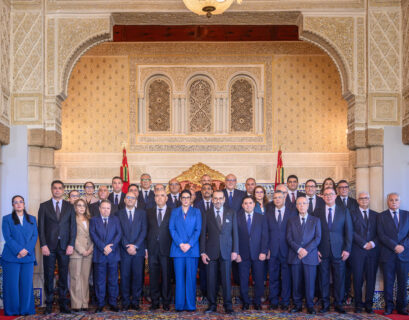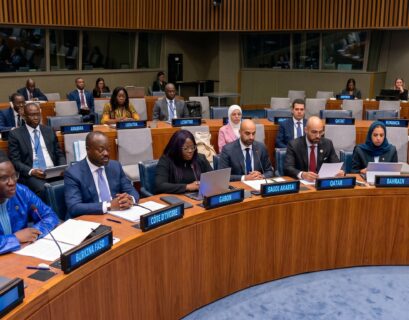

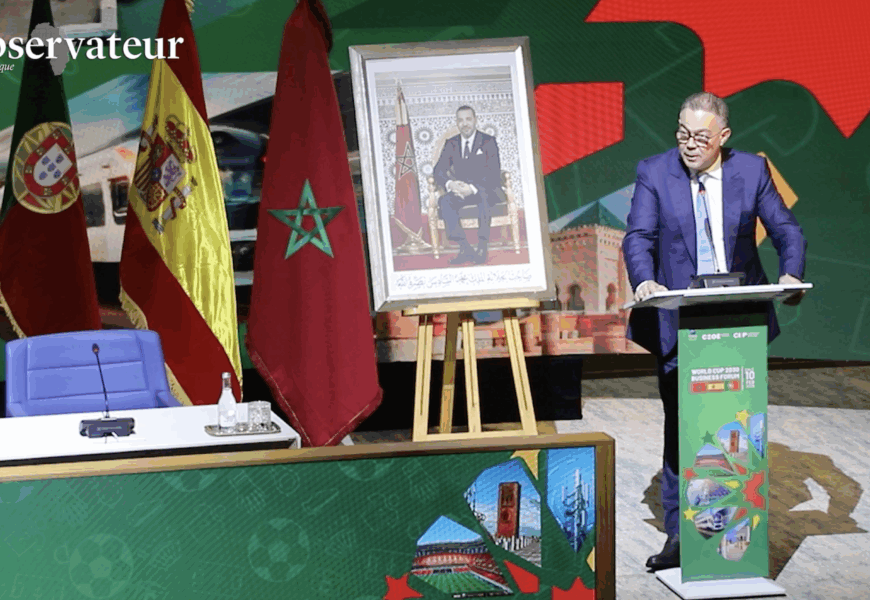
Building on the organizational success of AFCON 2025, Morocco is approaching the 2030 FIFA World Cup with the ambition of hosting a historic global event. Speaking before Moroccan, Spanish and Portuguese economic decision-makers gathered in Salé, Fouzi Lekjaa outlined the contours of an unprecedented centennial World Cup, driven by tripartite cooperation and the full mobilization of the business community.
The Mohammed VI Football Complex in Salé was not chosen at random to host the Morocco–Spain–Portugal Business Forum dedicated to the 2030 World Cup. The site, which now houses a permanent FIFA office, embodies the vision spearheaded by His Majesty King Mohammed VI, founded on sport as a lever for social, economic and territorial development. A comprehensive vision that Fouzi Lekjaa recalled from the outset, placing the organization of the World Cup within a trajectory initiated more than two decades ago.
The president of the Royal Moroccan Football Federation (FRMF) first paid tribute to the recent success of AFCON 2025, organized “under exceptional conditions.” He fully credited national expertise for this achievement: “Everything was designed, carried out and organized by Moroccan companies, relying exclusively on national expertise.” For Fouzi Lekjaa, this continental edition demonstrated structural maturity and marked a decisive step toward the global milestone ahead.
An Unprecedented Intercontinental and Centennial World Cup
The 2030 World Cup will be unique in many respects. It will celebrate the tournament’s centenary and, for the first time, be hosted across two continents—Africa and Europe—by three countries bound by centuries of shared history and complementarity. “Morocco, Spain and Portugal share a rich civilizational, cultural and economic capital that provides every guarantee of success,” stressed Fouzi Lekjaa.
Beyond symbolism, the challenge is organizational. The tournament will feature 104 matches played within a condensed timeframe, under an unprecedented mobility framework. “A national team could play in Madrid, then in Marrakech, before traveling to Lisbon,” he explained, emphasizing the need for complete consistency in logistics, infrastructure, transport and security. This challenge calls for constant coordination and strengthened collective intelligence.
For Lekjaa, businesses lie at the heart of this equation: “Whatever their size—from the smallest structure to the major companies responsible for building stadiums or managing ticketing and security—each is called upon to engage fully and intelligently.” The World Cup is thus conceived as a driver of sustainable value creation, far beyond the sporting event itself.
Multi-Party Cooperation
Other speakers echoed this perspective. Chakib Alj, President of the CGEM (General Confederation of Moroccan Enterprises), called for the establishment of an operational framework for collaboration among companies from the three countries, particularly to enable SMEs to seize the opportunities offered by the 2030 World Cup. “By joining our forces and sharing our expertise, we will gain in competitiveness and resilience,” he stated.
On the Spanish side, Antonio Garamendi, President of the CEOE, underlined that the project goes far beyond organizing a sporting competition. In his view, the 2030 World Cup represents “a platform for economic, social and territorial integration,” grounded in a long-term vision and a balanced partnership. Investments will primarily target infrastructure, mobility, tourism, innovation and technology, with particular attention to sustainability.
A similar assessment came from Portugal. Nuno Gabriel Cabral, advisor at the Portuguese Embassy, highlighted the prospects for value creation, job generation and lasting partnerships, emphasizing the strategic potential of this project to strengthen Euro-African cooperation.
Conceived as a unifying endeavor, the 2030 World Cup aims to bring peoples closer together, mobilize youth on both shores of the Mediterranean, and extend its economic and human impact far beyond the final whistle. For Fouzi Lekjaa, the objective is clear: to make this World Cup “the best in history.”