


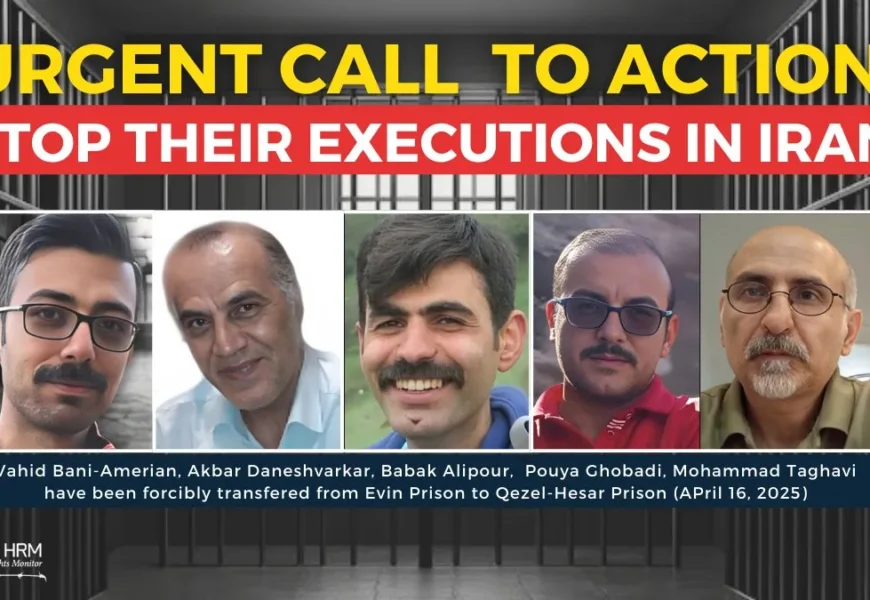
Five political prisoners, sentenced to death and accused of belonging to the People’s Mojahedin Organization, have just been transferred to Qezel Hesar prison after being beaten. For political analyst Hamid Enayat, this maneuver is part of a strategy of terror aimed at crushing all opposition.
The signs of bloody repression are multiplying in Iran. From Evin prison, sources confirm the brutal transfer of five political prisoners to Qezel Hesar prison, after their beating, reveals Iranian political analyst Hamid Enayat in a recent article.
All the transferred prisoners are sentenced to death for alleged membership in the resistance units of the People’s Mojahedin Organization of Iran (PMOI). Enayat also revealed their identities. They are Vahid Bani Ameri, Pouya Ghobadi, Shahrokh Daneshvarkar, Babak Alipour, and Mohammad Taghavi. According to him, this transfer could well be the prelude to their execution.
Dark series
This scenario would not be hypothetical, judging by Iran’s precedents: on July 27, two other political prisoners, Mehdi Hassani (69) and Behrouz Ehsani (48), were already hanged in the same prison for the same charge.
Enayat places these events in a broader context: that of the so-called “104 people” trial, whose 36th hearing was held on July 27, according to the official Mizan agency. Most of the defendants are members or sympathizers of the PMOI.
“This trial has nothing of a true judicial procedure,” he denounces. It is, according to him, a staged show to link the regime’s recent military and intelligence defeats to supposed espionage for the Mojahedin, thereby creating a climate of fear conducive to crushing all opposition.
For the political analyst, this “judicial masquerade” also serves as a smokescreen, masking the inefficiency of the Revolutionary Guards during the recent conflict.
“Behind it lies a clear strategy: to terrorize the population to prevent any uprising, neutralize the active resistance units, curb the growing support of the youth for these groups, and repeat, under the guise of accusations of ‘collective moharebeh’ and ‘collaboration with the enemy,’ the massacre of 1988,” laments the political analyst.
Mobilization
This massacre, he recalls, had cost the lives of about 30,000 political prisoners, summarily executed for their loyalty to a democratic opposition. “A massacre foretold, in plain sight,” warns Enayat. The warning is shared on the international stage. Stephen J. Rapp, former Chief Prosecutor at the International Criminal Tribunal for Rwanda, warns in the Washington Post: “If the current trajectory continues, the number of executions in Iran in 2025 could exceed all records in recent memory, except perhaps for the horror of 1988.”