

The Algerian junta operates much like a semi-automatic pistol. We all know how it works. The weapon fires a bullet, then uses the energy generated by that shot to eject the spent cartridge case and chamber the next round.
In our case, the pistol is the regime’s communication strategy.
The Algerian authorities maintain an arsenal of talking points, deploying them according to circumstances. But because they know that no single issue can capture public attention forever, they always have another round ready to fire.
Let us take an example.
The regime makes extravagant claims about industrialization and the growing share of manufactured goods in Algeria’s exports, which remain overwhelmingly dominated by hydrocarbons.
It announces enormous projects involving automobile manufacturing, food processing, tire production, cooking oil, mayonnaise, and virtually anything else imaginable. It also boasts of foreign investments involving astronomical sums that perhaps only Elon Musk could mobilize.
For a while, the public believes the promises. Then the subject gradually fades from memory.
Opposition figures denounce the announcements as scandalous. And when the smoke finally clears, people discover that much of the spectacle was just that: smoke.
That is precisely when the mechanism automatically chambers the next round.
A new subject is introduced.
This time, it is seawater desalination, accompanied by yet another stratospheric figure: 1.4 billion cubic meters per day.
Even a science-fiction film would hesitate to go that far.
Never mind. The authorities insist: 1.4 billion it is.
Once again, opposition figures operating from exile — since openly opposing the regime from within Algeria is hardly an option — expose what they describe as a deception.
And the whole story goes down the drain, so to speak.
The regime then returns to its perennial favorite: the Polisario Front and the Western Sahara dispute.
Algeria is a member of the United Nations Security Council, and the authorities promise that the world is about to witness something extraordinary.
Yet, despite Algeria’s presence on the Council, Morocco emerges with a diplomatic victory.
Another shot gone astray.
But the mechanism is automatic, and the next round is already in the chamber.
This time, the accusation is that Morocco is poisoning Algeria’s waterways.
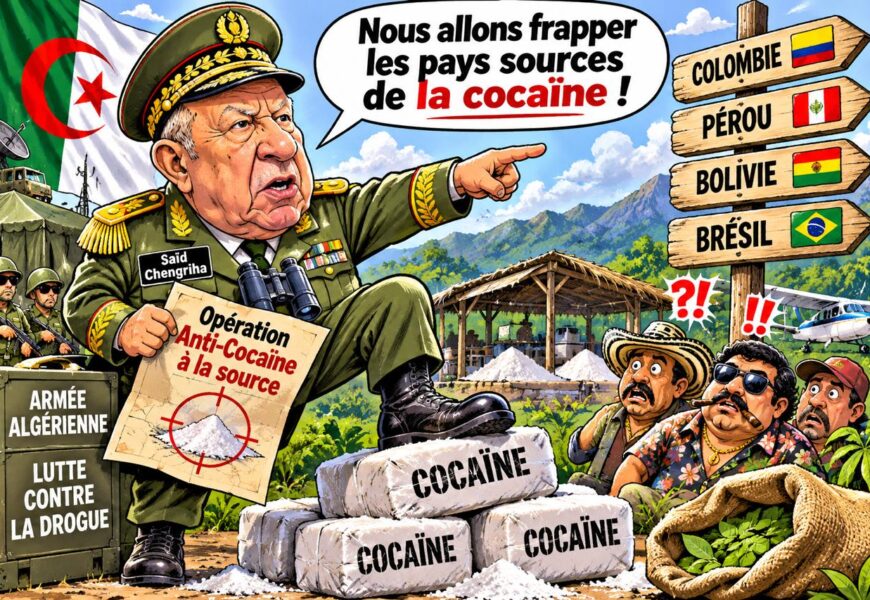
When that story fails to gain sufficient traction, the authorities move on to another campaign: the fight against drug trafficking, which, according to the regime, is “killing Algerian youth.”
The junta announces its determination to tackle the problem at its source.
There is, however, an uncomfortable question.
Major drug-trafficking scandals in Algeria have raised allegations involving individuals connected to political and military circles. These cases raise questions about possible complicity, corruption, and protection within influential networks.
Several large cocaine shipments have been intercepted, triggering investigations involving people with connections to powerful political and military figures.
Observers have also suggested that Algeria functions not merely as a consumer market but as a transit country for hard drugs destined for other markets. Algeria’s relatively limited purchasing power is sometimes cited as one factor supporting that interpretation, although it does not, by itself, establish the scale of domestic consumption.
The Cocaine Scandal That Shook Algeria
In 2018, a shipment of cocaine concealed in frozen meat imported from Brazil was intercepted near Oran.
The affair exposed relationships between the importer Kamel Chikhi, widely known as Kamel the Butcher, and several influential personalities.
It triggered investigations and court proceedings involving allegations of corruption and influence peddling.
Khaled Tebboune, the son of Algeria’s current president, was prosecuted in a related influence-peddling case.
His release and acquittal in February 2020, shortly after his father assumed the presidency, prompted accusations from opposition figures that political influence may have played a role. However, such allegations should not be confused with a judicial finding of presidential interference, nor was Khaled Tebboune convicted of drug trafficking.
The affair nevertheless raised broader questions about the connections between business interests, criminal networks, and political power.
According to INTERPOL, the quantities of cocaine intercepted and the geography of trafficking routes suggest that Algeria also serves as a transit territory for shipments destined for other markets, particularly in Europe.
This means that not all cocaine intercepted in Algeria was necessarily intended for domestic consumption.
And that is where the issue becomes particularly relevant to European security.
Millions of Psychotropic Pills Seized
Two operations carried out in 2026 deserve particular attention.
February 2, 2026: Two trafficking networks were dismantled in Algiers. Approximately 4.29 million psychotropic tablets were seized, and 20 people were arrested.
November 4, 2026: Two additional networks were dismantled. Authorities reported 33 arrests, the seizure of more than one million psychotropic tablets, and 30 kilograms of cocaine.
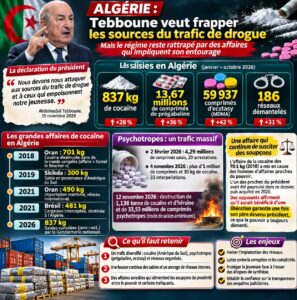
November 12, 2026: Algerian authorities announced the destruction of approximately 1.136 metric tons of cocaine and heroin, along with 33.53 million psychotropic tablets. These quantities came from previously seized stocks collected by several security services.
These figures illustrate the scale of the trafficking problem acknowledged by Algeria’s own authorities.
They also raise an important question: how extensive are the criminal networks operating within the country, and to what extent have they succeeded in penetrating economic or institutional structures?
What Can We Conclude?
Three main conclusions emerge.
First, cocaine shipments originating in South America and the proliferation of psychotropic-drug networks point to a much more diversified form of organized crime than the official narrative sometimes suggests.
The involvement of individuals connected to influential circles in certain judicial investigations has also fueled allegations of protection at high levels of the state. Such allegations, however, require evidence establishing the responsibility of specific officials.
Second, the Algerian authorities themselves acknowledge the magnitude of the problem.
The millions of tablets seized and the hundreds of networks dismantled are documented indicators of extensive trafficking activity, although they do not provide a precise measurement of domestic drug consumption.
Third, the Kamel Chikhi affair raises a separate and particularly sensitive issue: the relationship between economic networks, corruption, and public officials.
Can Algeria Really Strike at the Sources?
The question now is what the Algerian regime intends to do.
Striking at the sources of international drug trafficking is far easier said than done.
That may explain why President Abdelmadjid Tebboune refrained from naming a single country, region, or even continent when discussing the possibility of targeting drug-trafficking sources.
The geography of cocaine production and trafficking is well documented. But translating political declarations into effective international action would require cooperation, intelligence sharing, and coordination with foreign governments.
In any event, the semi-automatic pistol remains loaded.
The next round is already in the chamber.
Once the anti-drug campaign loses its political momentum, perhaps the authorities will finally turn their attention to the everyday concerns of Algerian citizens.
The fundamental question of economic development remains unresolved.
But the regime’s critics argue that the junta’s overriding priority is not development, but its own political survival.
And there is another question worth considering.
Is Algeria’s Anti-Drug Campaign Also a Message to Europe?
This is perhaps the most intriguing question for Europeans.
What if Algeria’s latest anti-drug campaign also serves a political purpose: distancing the country from any suspicion that its territory plays a role in supplying Europe’s illegal drug markets?
This remains a hypothesis, not an established fact. But it deserves examination in light of documented trafficking routes, major seizures, and the political communication surrounding the campaign.
The image is that of a wolf crying wolf.
A similar pattern can be observed, according to critics, in the controversy over water pollution.
Algeria, itself facing serious pollution problems affecting waterways and the Mediterranean coastline, has accused Morocco of polluting — or, more precisely, poisoning — a small cross-border watercourse.
The parallel is striking.
In both cases, the Algerian authorities present the country primarily as the victim of threats originating beyond its borders.
Yet the evidence also points to significant domestic problems that demand scrutiny.
The question is therefore not whether Algeria should fight drug trafficking. Of course it should.
The real question is whether a campaign directed at external sources can succeed without an equally determined effort to investigate trafficking networks, corruption, and possible complicity within Algeria itself.
And until that question is answered, the semi-automatic pistol of political communication will remain ready to fire its next round.