

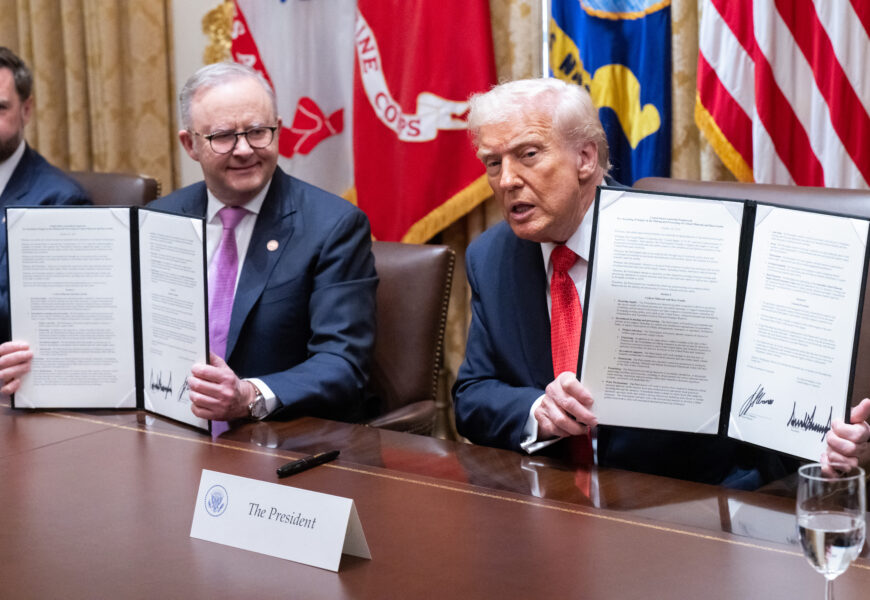
President Donald Trump and Australian Prime Minister Anthony Albanese have signed a landmark Critical Minerals Framework, marking a major step toward advancing both nations’ ambitions for energy and minerals dominance. The agreement—finalized after five months of negotiations—aims to accelerate the buildout of resilient, allied mineral supply chains and reduce reliance on adversaries.
Here is an 8-question-and-answer breakdown of the Australia–U.S. agreement.
Critical Questions by Gracelin Baskaran* and Kessarin Horvath*
Q1: What is the U.S.-Australia Critical Minerals Framework?
Q5: Why is Australia the United States’ indispensable partner in securing critical minerals?
Q6: What roles are Australian firms playing in developing the U.S. domestic mining industry?
Q7: What projects will this Framework Agreement support?
- Gracelin Baskaran is director of the Critical Minerals Security Program at the Center for Strategic and International Studies (CSIS) in Washington, D.C.
- Kessarin Horvath is a program manager for the Critical Minerals Security Program at CSIS.