
In the turmoil of the contemporary Middle East, as the region is being reshaped by major strategic shocks, another battle—less visible but just as decisive—is being fought: the battle of consciences.
The targeted strikes against Iran, the gradual dismantling of Hezbollah’s armed networks, the systematic pressure on Tehran’s regional proxies—all this reflects an irreversible geopolitical shift. The era of strategic complacency is ending. A new dynamic is taking shape, one that some are slow to recognize.
As the old order falters, as diplomacy reinvents itself under the constraint of reality, a certain rigid mindset clings to its slogans, to its fossilized narratives. And in this inertia, some choose to attack not the warmongers, but those who dare to think differently. What they seek is not debate, but ideological assignment, a moral tribunal without appeal.
I wrote, in the hours following a massacre of chilling brutality, an op-ed titled “We Are All Israelis.” The title, deliberately provocative in its form but profoundly humanist in its essence, was in line with the tradition of great surges of universal solidarity—like “We Are All Americans” after September 11, or “Je suis Charlie” after the Paris attacks.
That text was neither a matter of political alignment nor of ideological adherence. It was a cry—a cry of conscience in the face of the unspeakable. It was not about taking sides for one cause against another, but about recalling a simple truth: when civilians—women, children, the elderly—are murdered, in silence or with moral ambiguity, humanity itself is murdered a second time.
My position has never wavered. I consistently defend the inalienable right of the Palestinian people to dignity, to self-determination. A Palestinian state, as defined by the Palestinians themselves—in its form as in its substance—living alongside a secure and recognized State of Israel.
I have never compromised on this fundamental principle: justice for the Palestinians is not a bargaining chip—it is a sine qua non condition for any true, lasting, and mutually recognized peace.
But today, when free speech should be the foundation of responsible debate, some prefer invective over ideas. They believe themselves guardians of collective morality, but command only the language of suspicion and insult. Lacking arguments, they retreat into personal attacks, resorting to verbal violence unworthy of discourse, summoning animal metaphors and the vilest insinuations to try to tarnish what they cannot counter on substance.
These people do not debate. They designate. They do not build thought, they manufacture an enemy. They give themselves the right to judge consciences as if they were the arbiters. But the time of ideological excommunications is over.
Victor Hugo, in a flash of lucidity, wrote:
“You want the freedom to think? Begin by not hating those who think differently.”
This reminder has never been more vital. For it is precisely in the plurality of voices that a solid, peaceful, and forward-looking nation is forged.
Morocco, our land, has never been the extension of a single ideology. On the contrary, it is the heir of an ancient pluralism, of a proven coexistence, of a popular wisdom that rejects extremes. In a region marked by identity fractures, our country has long chosen balance, measured modernity, and freedom within respect.
Those who today seek to capitalize on the suffering of peoples to score a few political points by undermining another’s integrity betray not only the dignity of the Palestinian cause, but also the intelligence of their own public. For the people are not fooled. They know how to distinguish between sincere commitment and opportunistic exploitation.
I will continue, for my part, to write. To defend free speech. To uphold positions that sometimes disturb, but never betray my principles.
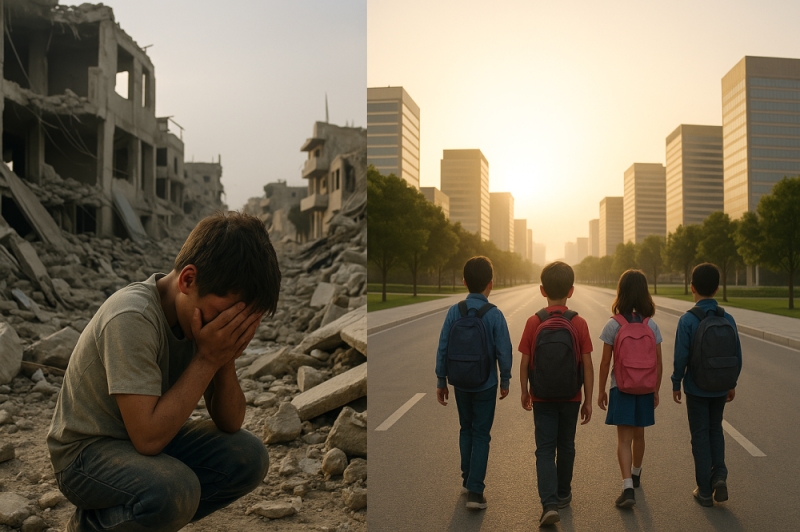
I will continue to believe that a reconciled Middle East is possible. And that Morocco, strong in its strategic lucidity and historical depth, can be an actor that builds bridges, not walls.
History will do the sorting. And as always, what will survive the noise is not the tumult of accusations, but the clarity of a straight thought.